Madison
County Genealogical Society
Minutes of the Meeting - September 8, 2016
The September 2016 meeting of the Madison
County Genealogical Society was held at the Edwardsville Public Library on
Thursday, September 8, at 7:00 pm.
President, Robert Ridenour, called the meeting to order.
GIFT
MEMBERSHIPS AVAILABLE
Do you have a family member that is
interested in (or even obsessed with) genealogy? A membership in the Madison
County Genealogical Society would be a very thoughtful gift. A gift card will
be sent to the recipient of any gift membership.
The following memberships are available:
Individual/Family Annual Membership $20.00
Patron Annual Membership $30.00
Life Membership $250.00
Contact our Secretary, Petie Hunter, at petie8135@att.net,
about a gift membership.
September
Meeting
On August 8, 2016, Lola DeGroff presented What to Load in
Your Covered Wagon. Lola DeGroff retired from the Department of Defense
following more than 20 years of government service. She is the Vice Regent of
the Illinois DAR, member of and past Regent of the Silver Creek DAR Chapter,
past State President of the Illinois Society US Daughters of 1812, treasurer of
the Shawnee Chapter Colonial Dames of the XVII Century, and a member of several
other lineage organizations.
Like many of you, our family took a trip this
summer. Before leaving, we checked maps so we knew which roads to take; packed
our clothes; and loaded the suitcase and a cooler with snacks in our car. Of
course, friends and family had our cell phone number to call in case of an
emergency.
This is certainly a far cry from tasks faced by families taking an adventure
west in the 1800s. At that time the primary communication was the federal mail
a slow, unpredictable service.
Yet, in one of the greatest migrations of modern times, spurred on by a
prolonged depression in our country, an estimated 500,000 people migrated west
between 1841 and 1866. They traveled to claim free land in the Oregon and
California Territories, many hoping to strike it rich by mining gold and
silver.
Those pioneers came from Illinois, Iowa, Indiana, Missouri, and as far away as
New York and New Hampshire. Moving itself wasn't new to them; many had moved
before as had their parents and grandparents before them.
Guidebooks, such as "Emigrants Guide to Oregon and California in
1845," promised the adventure would take three to four months. Mostly
these guidebooks were wrong. Most trips took six to eight months.
The "jumping off" place to the west lay in towns along the Missouri
River between St. Joseph and Council Bluffs. Emigrants began arriving in late
March so that when the snows had melted in early April, they were ready to go.
Others wintered in these then small towns, gathering their supplies, preparing
their wagons, or waiting for families or friends to join them.
Can you imagine what it took to get ready for such a journey? Of course we need
to remember, in those days people made nearly everything themselves. In her
diary, Keturah Belknap described making the linen for a wagon cover and sacks
for supplies. "… will spin mostly evenings while my husband reads to me.
The little wheel in the corner don't make any noise. I spin for Mother B. and
Mrs. Hawley and they will weave."
Thanks to detailed letters, journals, and diaries such as Keturah's, we learn a
lot about those journeys.
First, the overland wagon was built of seasoned hardwood. During the trip, as
the pioneers discovered, the wagon would have to withstand extreme variations
in temperature. Typically the travelers used a farm wagon with a flat bed about
10 feet wide and 15 feet long, with sides two feet high.
Benjamin Bonney recalled his father worked for months building a wagon sturdy
enough for river crossings and mountain travel. Since the wagon could be loaded
with up to twenty-five hundred pounds it required four to six yoke of oxen to
pull it. The family cow went along too.
Built to be amphibious, the wagon had a tar bucket hanging from the side and
the covering was a double thickness of canvas, made as rainproof as oiled
linen, muslin or sailcloth could be. Since parts could break, spare parts were
kept under the wagon beds.
So now that the wagon was constructed, what should be packed inside? Well, our
resource, "The Emigrants Guide," recommended that each emigrant have
200 pounds of flour, 150 pounds of bacon, 10 pounds of coffee, 20 pounds of
sugar, and 10 pounds of salt. Plus they should have corn meal, chipped beef,
rice, tea, dried beans and fruit, saleratus (baking soda), vinegar, pickles,
mustard, tallow, rifles, and a supply of gunpowder and lead. And, oh by the
way, don't forget some cash to pay the ferryman at the river crossings and some
trinkets to trade with the Indians.
Female pioneers sewed pockets along the sides of the wagon canvas to hold their
most important things: a Bible, quinine, citric acid, matches in a jar with a
tight fitting lid, and some small toys to keep the children occupied. Keturah's
young son, Jessie, had some marbles and sticks and blocks he used as oxen. He
used his mother's workbasket as a covered wagon and played "Going to
Oregon."
Many women's diaries describe using home remedies during their travels, and
many carried quinine for malaria, hartshorn for snakebites, citric acid for
scurvy, as well as whiskey for everything else. These remedies were tested
frequently on their long voyage injuries, cholera, mountain fever, dysentery,
falls from wagons, childbirth these are but a few of the problems confronted.
How did the people making this enormous trip feel in anticipating their
journey? Many were optimists who focused on the opportunities that lie ahead.
Others, such as the mother of nine-year-old Barnet Simpson, were pessimists.
She prepared burial shrouds for each member of the family before departing for
Oregon. Some men also shared this fatalist spirit, taking along boards
specially cut for making coffins.
Unfortunately the journals are filled with reports of loved ones dying and
being buried along the trail. In his classic book, "The Great
Plains," Walter Prescott Webb told of a report estimating that each mile
of the 2,000 mile journey cost seventeen lives.
Some of the main problems that faced the pioneers were finding feed and water
both for the cattle and for themselves. Often the water found was not useable
and many humans and animals got sick or died from drinking it. When the food
was gone, the mountain passes closed by snow, many emigrants left many of their
belongings behind and packed necessities on mules in a desperate attempt to
reach the end of their journey.
Let's look for a moment at a typical day for a female pioneer. She did the
usual domestic chores: prepared the meals, washed the clothes, cared for the
children, milked the cows. But she also drove the ox teams, collected buffalo
chips for fuel, and, if the river waters were high, everything inside the
wagons sometimes all two thousand pounds of supplies and possessions had to be
unloaded, placed on rafts, and repacked again on the other side.
Lodisa Frizzell said, "All our work here requires stooping; not having
tables, chairs, or anything it is very hard on the back."
One pioneer recalled that the evening's milking was used for supper, but that
milked in the morning was put into a high tin churn and the constant jostling
formed butter and delicious buttermilk by night. Another rolled out her pie
dough on the wagon seat beside her while moving — multi-tasking indeed.
Greatly outnumbered by the male travelers, female pioneers sought out other
"sisters." They no doubt enjoyed another woman's company. But from
more of a practical side, one or two women with their long full skirts gave
privacy to another during childbirth or just to relieve herself travelling the
treeless, flat plains with so many men.
In a letter to her sister, Betsy Bayley recalled a humorous story although
probably not funny at the time. "At Fort Hall," she wrote, "the
Indians came to our camp and said they wanted to trade. They wanted to trade
horses for wives. Mr Bayley joked with them, and asked a young Indian how many
horses he would give for Caroline. The Indian said ‘three.' Mr Bayley said,
`Give me six horses and you can have her,' all in a joke. The next day the
Indian came after her and had the six horses and seemed determined to have her.
He followed our wagon for several days, and we were glad to get rid of him
without trouble."
Packing up and moving so many miles across the, then undeveloped, country
required a great deal of courage and sacrifice leaving family, friends and
belongings behind. Because of our nurturing nature, this was no doubt very hard
on the mothers and daughters. Hopefully you share my admiration for those brave
women who risked so much to settle the western United States.
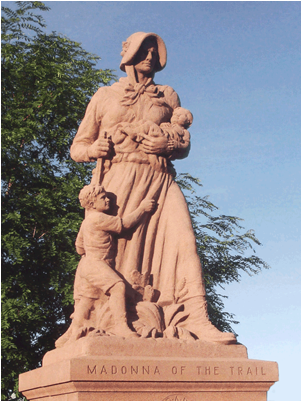
As you probably know, the Daughters of the American Revolution (DAR) has
recognized the sacrifices and courage of these pioneer women with Madonna of
the Trail monuments in 12 states along the trail. One is in nearby Vandalia,
Illinois.
Consider these words by Emerson Hough:
"The chief figure of the American West, the figure of the ages, is not the
long-haired, fringed-legging man, riding a raw-boned pony, but the gaunt and
sad-faced woman sitting on the front seat of the wagon, following her lord
where he might lead her, her face hidden in the same ragged sunbonnet which had
crossed the Appalachians and Missouri long before. That was America, my
brethren! There was the seed of America's wealth. There was the great romance
of America the woman in the sunbonnet; and not, after all, the hero with the
rifle across his saddle horn. Who has written her story? Who has painted her
picture?"
A pioneer lawyer at a 4th of July celebration of the Sons and Daughters of
Oregon Pioneers many many years ago, evidently agreed saying, "I think the
time has come when we should give due credit to the Pilgrim Mothers, for they
not only endured all the hardships of the Pilgrim fathers, but in addition
endured the Pilgrim Fathers besides."
Sources:
* Cassie's Journey: Going West in the 1860s, Brett Harvey
* Covered Wagon Women, Diaries & Letters from the Western Trails,
1840-1890, Volume I, Kenneth L. Holmes
* Women's Diaries of the Westward Journey, Lillian Schlissel
* Westward Expansion: An Interactive History Adventure, Allison Lassieur
* What People Wore During the Westward Expansion, Allison Stark Draper
* Westward to the Pacific: an overview of America's Westward Expansion, Ray
Allen Billington
This presentation was very well received and provoked many questions and comments.